Showing posts with label foundation. Show all posts

Monday, June 1, 2009

Supering Made Easy

Every beekeeper knows that if they want to produce honey that they must have a colony which is strong enough to draw and fill supers. Here is a quick rundown on how I super my honey producing colonies. When the colony is strong enough only then is it appropriate to add a super. When using frames with foundation I will use ten frames in the super. When using foundation only add one super at a time. When this super is 90% drawn it is time to add another super with foundation. Always use ten frames when using foundation.

The title to this post, "Supering Made Easy," is named so because I intend to show you the easiest way to super a colony in order to achieve the most harvest. For this post I have used supers of drawn comb. These supers were extracted last year and have been stored safely away from wax moths, mice, and other unwanted pests. In the below picture I intend to super the colony on the right. This is a rear view of the colony. There are two empty supers over the inner lid on this colony. They are there to surround t6he feeder jars which are over the inner lid. These feeders will be removed so the honey from the colony remains pure.


After the inner lid is removed a queen excluder is put in its place before the first super goes onto the colony.


The supers which I am placing atop the hive contain nine frames of drawn comb. Once the comb has already been extracted it is OK to use only nine frames. The bees are less likely to build any burr comb between the frames after they have drawn out. Also the frames are easier to uncap as the bees have drawn the comb out past the frames. Uncapping goes a lot faster when you are uncapping frames that are drawn out farther than when the bees have ten frames per super. Always use ten frames with foundation or else you could end up with a nice mess. When superimg in the way I am disclosing to you be sure to only use drawn comb as pictured below.


When using multiple supers of drawn comb it is pertinent to have an upper entrance. This allows the field bees easy access to the supers when returning from gathering nectar. This relieves congestion within the brood chambers since the field bees do not have to traverse the combs which contain brood and are covered with the bees which are incubating the brood. It also helps the field bees to bypass the queen excluder. If you have a colony strong enough the bees will have no problem using the upper entrance. In the picture below you can see I created the upper entrance by notching the bottom of the second super.


In this picture I have added three additional supers of drawn comb. The fourth super from the bottom, or second from top, can also be notched for another upper entrance.


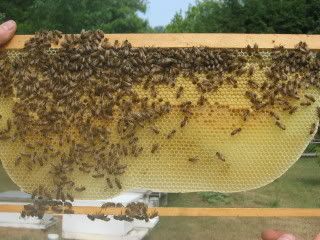
The advantages to having drawn comb over using foundation are immense. The bees must consume approximately eight pounds of honey in order to produce one pound of wax. Since nectar has a moisture content of over 80%, which is over four times the moisture content of honey (which is between 16% and 18%) a colony must obtain around 32 pounds of nectar to get the 8 pounds of honey (after evaporated) to make the one pound of wax. Save your wax!!! Of the five supers of drawn comb which I placed atop this colony, the bees must nearly fill all five supers with nectar in order to evaporate the nectar down to one super of honey. It is extremely beneficial for your bees for you to save the comb that they have labored to construct. I know people like cut comb or chunk honey but they get very little of that from me. The comb does so much more for the bees than it does for any human being who chews on it for awhile just to spit it out.

This is the easiest way I know of to super a colony. If you have drawn comb you do not need to labor over installing foundation into frames or assembling frames to hold the foundation. Do yourself a favor and protect all your comb.

I could not help myself, but after taking these pictures I used the top deep on this colony and the one beside it to make up some more nucs so we will not have any future posts showing how beneficial using drawn comb in your honey supers is. I can testify from past years experience that you can obtain more than twice the amount of honey from a colony when using drawn comb as opposed to using foundation.

Tuesday, January 1, 2008

When I Got Started Beekeeping

With the beginning of the new year, I have decided to start a blog to post my beekeeping activities through the upcoming year. This year I plan on raising some queens, making some nucleus colonies, doing some colony extractions, and harvesting honey. Hopefully the documentation of my personal experiences along with some pictures may help any of you reading this who is interested in beekeeping or are already a beekeeper.
I have been keeping bees 1997. My ex-wife's grandfather, Fred Covert, gave me my first hive. This was the next spring after the varroa mite hit hard here in Boone County, WV. Fred had nearly thirty colonies in his apiary. In the spring of 1996 he discovered that nearly all of his colonies had succumbed to some form calamity and was left with only three colonies. Not knowing what a mite was he speculated another culprit, American Foulbrood (AFB). Since he suspected AFB as being the downfall of his colonies, he burned nearly 27 hives. Each hive contained two deep hive bodies, bottom boards, frames, and inner and outer covers. Some colonies also had some shallow supers left on them from the previous year. I must say that this was an expensive mistake because a dead-out, a colony which has died, does not need to be destroyed if they met their demise at the hands of varoasis.
Having been interested in bees and all form of insects since childhood, I implored Fred to let me get a colony of bees from him. My timing could not have been worse for wanting him to help me get a start. He just didn't have the resources to help me out. He told me that if I wanted some bees that I needed to learn how to keep them first. So under his wing I went. The first thing we did was to build some new hive bodies, bottom boards, and inner and outer covers to replace the ones he burned. He quickly got on the phone with Kelly's and ordered a large quantity of frames and foundation to replace that which he destroyed. After toiling in the workshop in the evening for about a week the frames and foundation finally arrived. This was my first lessons in hive construction and the components of the hive.
Of course Fred was more than happy to have a young eager apprentice. He was 79 at the time and had a little trouble carrying around hive bodies due to the colostomy bag he wore under his shirt. I was 20 at the time so I became his mule as well as his student. The weekend after we got the frames assembled and hive bodies painted, he had me come to his house to help him. My first task was to carry enough woodenware up the hill to where his colonies were located for three equal splits. He was the first to go up and he had a chair there in which he promptly sat as I made a few more trips up and down the hill. Next I had to go after his beekeeper's box. It's a box that contains veils, hive tools, smokers, matches, and few other essential items for working colonies. When I returned with the box, that's when he reached into his shirt pocket and pulled out three little wooden cages.
The wooden cages had a hollow part covered by a small screen. He let me hold one and asked if I knew what was in it. I simply said, "Bees." He then asked if I seen anything special about the bees. "No," I replied. I was then informed that they were queen cages and was told about the duty of the queen. Of course he told me a lot about bees when we were making the new hive bodies in the shop but now I had a visual aid. I didn't even realize I was looking at a queen bee the first time I seen one.
Anyway, to not get into too much detail, we made three splits with the queens he had. I got to wear the veil and gloves and was the official smoker puffer which I thought was cool. He explained what he was doing as he went through the colonies and showed me brood, eggs, drones, pollen, and the usual stuff you'll see in a colony. I thought he was so brave since he was not wearing any veil or gloves. I now know that him not wearing his PPE, personal protection equipment, was due to having 60+ years of experience, not bravery. So this was my first actual experience in beekeeping, making splits. I mostly just watched, listened, carried stuff, and gave a puff of smoke when he told me to but it was a wonderful day and one that I'll never forget.
At the end of May this same year, two of the survivor colonies had built up enough to swarm. I lived nearby and was fortunate enough to be home at the time. He actually told me night before to stay close to home because he was going to need me to help him catch a swarm. I've seen him during the years after this to sit on his back porch and watch up the hill and point to a hive and say, "That hive is going to swarm in a day or two." It's so amazing because he's hardly never been wrong. My phone rang about shortly after noon and he told me to come up and catch this swarm for him.
When I got there he challenged me to locate the swarm in the trees. I couldn't find it. After he pointed it out I don't know how I could have missed it. I retrieved the swarm out of a white pine about thirty foot from the ground. I don't think Fred is ever as happy as he is when he catches a swarm. I caught one more for him that year. I didn't get to help with the honey harvest because he didn't end up with much and did what little he had with his wife. He showed me how and when to place supers on a colony that summer. That autumn, the bee inspector came by and showed us how to use Apistan strips for varroa. The WV State Dept of Ag gave away Apistan and demonstrated its use to registered beekeepers that year due to all the losses experienced statewide the previous year.
All eight of his colonies had survived the winter. We went into the wood shop again and started making more equipment. He got on the phone and ordered more frames and foundation again. About the first of April we split the eight colonies into sixteen. I caught him a few more swarms a few months later. The last two swarms that we caught were early in June. I was given those two swarms as my first colonies. I'll never forget how proud I was as I set up a little stand on the hill behind the house and put those hives on it. I think the reason I appreciated the colonies so much was that I worked for a beekeeper to become a beekeeper. I had made and painted the hive bodies. I had made and painted the bottom boards. I made the inner covers and outer covers. I helped turn three survivor colonies into 16+. I had learned a great deal about beekeeping in the 16 months leading up to having my own hives as Fred's helper. Though I could have bought a couple hives from someone for a couple hundred dollars, I' glad that I did not and learned for the year before I got mine. To me those two colonies were priceless.